
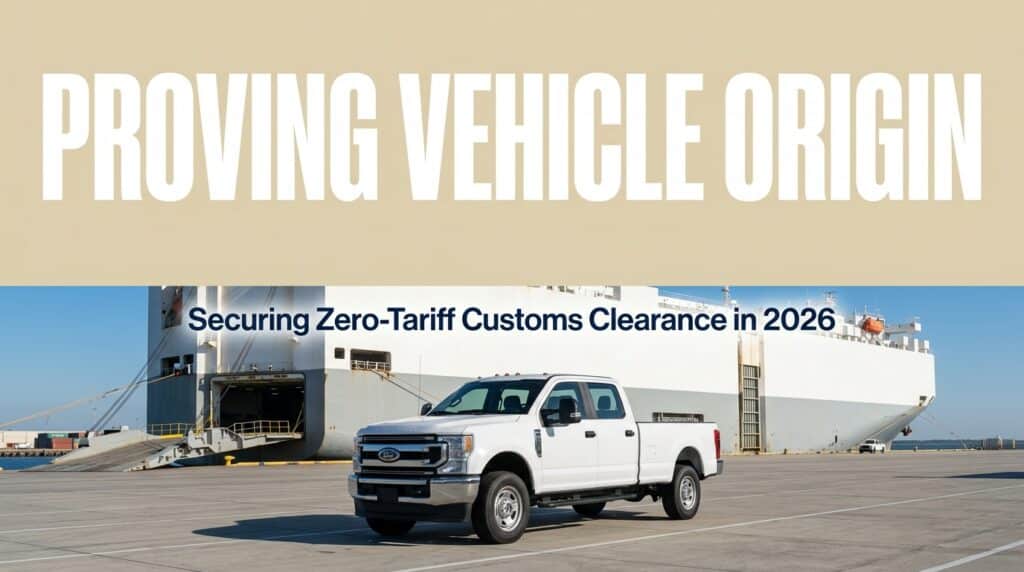
How to Prove US Origin for Zero-Tariff European Car Clearance
Navigating the Procedural Demands of Transatlantic Vehicle Customs
Navigating the shifting frameworks of international maritime transit requires strict attention to emerging customs mandates. While the implementation of the historic Turnberry trade pact legally established a framework for duty-free automotive imports, capturing these benefits at the European border demands thorough documentation from the importer. European port officials enforce rigid verification standards on incoming cargo, placing the full burden of proof onto the shipping consumer. To successfully secure a zero tariff status, international buyers must establish an ironclad paper trail that satisfies the exact structural criteria used to ship American cars to Europe affordably across global shipping lanes.

The Missing Document Paradox and Secondary Evidence Stacks
The primary administrative hurdle facing international vehicle collectors stems from the unique lifecycle of domestic vehicle titles. When a manufacturer produces a new vehicle in the United States, it issues a formal Manufacturer Statement of Origin. However, this factory certificate is surrendered to local state departments of motor vehicles upon the vehicle first retail sale to generate a standard road title. Because a fresh certificate cannot be reissued for a pre-owned car, customs brokers must utilize alternative evidence to demonstrate compliance with standard EU import duty exemptions parameters.
- Exporters must utilize verified vehicle history documentation to substantiate historical domestic operation and validate core transatlantic automotive tariff rates compliance.
- Verifiable state title chains provide European customs inspectors with concrete geographic tracking records across automated RoRo port logistics automation pipelines.
- Including explicit manufacturing declarations on commercial bills of sale protects shipping lines from sudden maritime port departure cutoffs.
- Exhaustive paper trails ensure that the target vehicle successfully bypasses the historical ten percent baseline tariff assessment.
Decoding the Vehicle DNA through Identification Stamping
Every vehicle rolling off a domestic assembly line carries a permanent, immutable digital footprint within its standard structural stamping codes. European customs officers are highly trained to cross reference these physical identification markings directly against the digital systems of the Union Customs Code. A vehicle identification number that initiates with the numeric digits one, four, or five provides immediate physical confirmation of United States assembly plant origin. Relying on this structural stamping data allows logistics coordinators to verify key compliance factors long before the vehicle approaches the loading ramp of an ocean vessel.
- Logistics personnel physically inspect chassis plates to guarantee absolute customs vehicle cargo compliance at the departure dock.
- Matching structural identification marks to international titles enables the smooth coordination required to export pickup trucks overseas securely.
- Importers must execute deep technical pressure washes to clear strict European destination import agricultural inspections.
- Comprehensive structural verification protects vehicle assets from being misclassified under standard imported vehicle customs fees schedules.

The Direct Transport Trap and Technical Customs Coding
A critical clause within the European Union non-preferential origin framework dictates that the physical continuity of the shipping route is just as vital as the assembly birthplace of the vehicle. Under regional customs directives, an American built vehicle will be denied the zero percent preferential tariff if it is transshipped or routed through a third-party nation port without strict, unbroken customs oversight tracking. To protect the tax exemption, specialized customs brokers must enter Preference Code three hundred and Document Code U one hundred and ninety on the single administrative document, making direct ocean routing a financial necessity.
- Securing direct point to point oceanic bills of lading protects buyers from fluctuating ocean freight shipping rates.
- Unbroken transit lines minimize administrative delays and ensure a transparent, predictable breakdown of car shipping costs.
- Coordinating terminal arrival with specialized forwarders simplifies vehicle collection across inner inland European auto transport pathways.
- Utilizing direct maritime links preserves the downward compounding effect that slashes total value added tax assessments across all transoceanic vehicle transit paths.

Securing Your Origin Documentation Stack for Final Clearance
Successfully navigating the complex paperwork requirements of the Turnberry trade agreement demands an assertive approach to international document preparation. Because different European ports exercise independent scrutiny, compiling an expansive verification stack prior to port delivery is the only definitive method to eliminate custom duty exposure. Aligning your vehicle logistics with an elite maritime shipping specialist ensures that every title, history report, and customs code is perfectly formatted for immediate port acceptance. Finalize your transatlantic shipping strategy and protect your capital today by securing a professional ship vehicle from USA to Europe operational analysis.