

Clear Your Imported Car Through US Customs
US Customs Brokerage & Port Clearance Services for Imported Vehicles
Navigating U.S. Customs and Border Protection (CBP) entries can be a costly legal minefield for vehicle importers. Whether you are importing a modern car, a foreign-purchased classic, or relocating a POV, our licensed customs brokerage team manages your ISF filings, secures required customs bonds, and ensures 100% compliance with EPA and DOT federal mandates to release your vehicle seamlessly at the port.

Clearing an ocean-bound vehicle through U.S. Customs and Border Protection (CBP) is not a simple matter of paying standard entry fees. The transition from international waters to domestic release requires legal validation across multiple federal databases simultaneously. Mistyping a single HS tariff code or failing to account for overlapping agency jurisdictions will immediately ground your cargo.
Self-Filing vs. Licensed Brokerage Clearances
| Port Challenge | The Risk of Self-Filing / Generic Freight Forwarders | The Ship Overseas Licensed Broker Solution |
|---|---|---|
| ISF 10+2 Submission | Missed deadlines or data errors trigger automatic $5,000 CBP liquid damages penalties before arrival. | Direct Automated Broker Interface (ABI) connection ensures flawless, legally bound real-time filing transmissions. |
| EPA & DOT Validation | Improperly completed forms (EPA 3520-1/DOT HS-7) cause permanent vehicle impoundment or forced export. | Pre-clearance documentation auditing guarantees total compliance with federal environmental and safety regulations. |
| Customs Bond Structuring | Inability to secure single-entry or continuous customs bonds halts the entry process entirely at the pier. | Immediate underwriting and application of correct customs bonds to cover total estimated vehicle duties seamlessly. |
- Automated Tracking: Our customs brokers utilize integrated systems to lock onto manifest data directly from arriving vessels well before port entry.
- Multi-Agency Ties: We simultaneously clear entries through CBP, the Department of Transportation (DOT), and the Environmental Protection Agency (EPA).
- Financial Security: We guarantee transparent duty classifications, protecting you against hidden port processing surcharges.
Critical Warning: Port terminals will only grant a very narrow “free time” window (typically 4–5 days) after a RoRo ship unloads before charging extreme daily storage fees. Having a licensed broker ready to file ahead of arrival is the only reliable way to protect your budget.
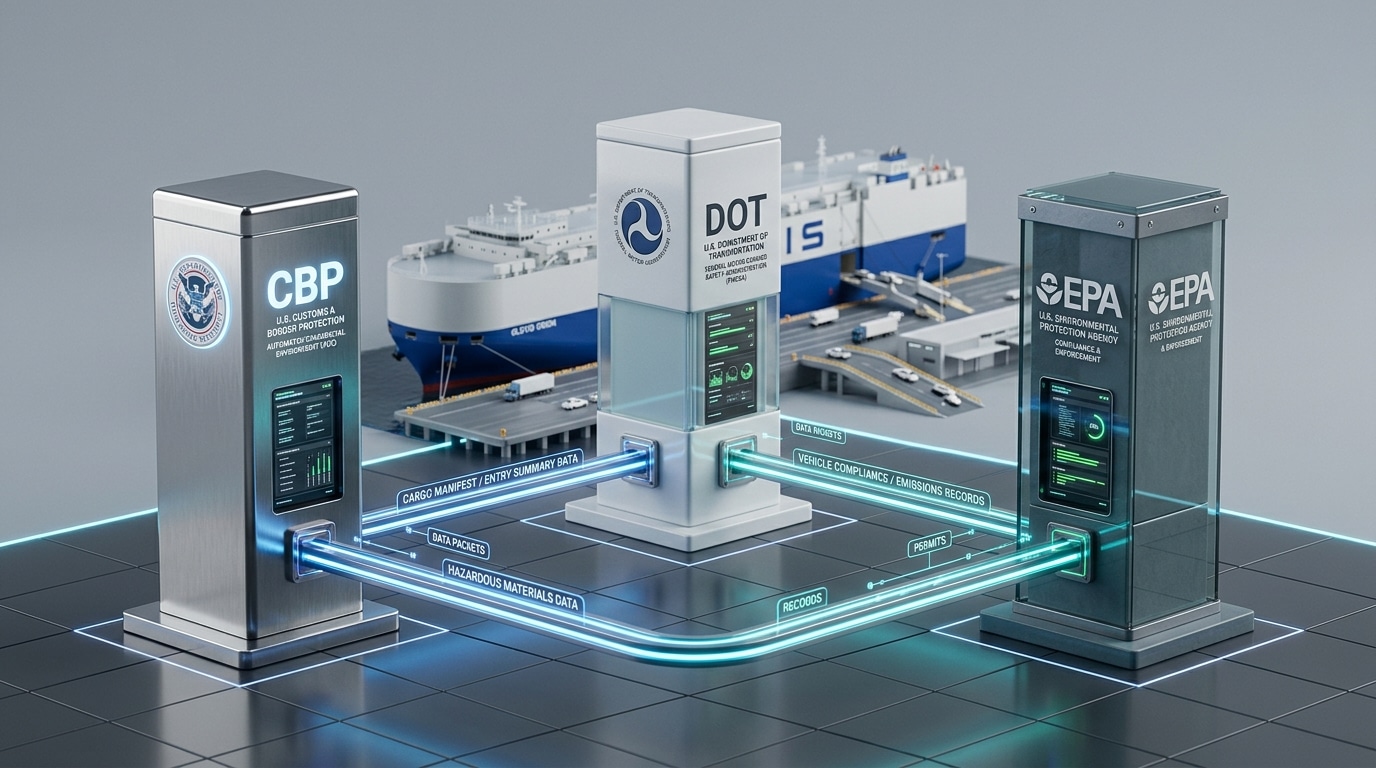
To successfully clear an imported vehicle into the United States, your shipment must simultaneously satisfy three separate federal regulatory frameworks. A mistake with any single agency will cause your vehicle to be held indefinitely at the port or ordered for destruction.
| Federal Agency | Mandatory Filing Requirements | Critical Broker Verification Steps |
|---|---|---|
| CBP (U.S. Customs & Border Protection) |
Form 7501 (Entry Summary) & Importer Security Filing (ISF 10+2). | Locks in precise Harmonized Tariff Schedule (HTS) classifications and values to calculate duties correctly. |
| DOT (Department of Transportation) |
Form HS-7 (Declaration of Vehicle Conformity). | Verifies safety compliance or qualifies the vehicle under strict exemptions like the 25-year rule. |
| EPA (Environmental Protection Agency) |
Form 3520-1 (Importation of Motor Vehicles). | Ensures the vehicle meets US emissions standards or securely qualifies for classic/historical engine exemptions. |
Note: Compliance documents must be electronically logged through the Automated Broker Interface (ABI) engine prior to the arrival of the RoRo carrier vessel to avoid processing delays.

Federal maritime law dictates that an Importer Security Filing (ISF 10+2) must be electronically transmitted to U.S. Customs and Border Protection at least 24 hours before your vehicle is loaded onto the vessel at the foreign port. As licensed customs brokers, Ship Overseas connects directly to CBP headquarters via the Automated Broker Interface (ABI), bypassing third-party delays and securing your cargo’s legal entry status in real time.
- Direct Server Connection: Unlike generic freight forwarders who must outsource clearance to third parties, our direct ABI line eliminates lag, ensuring your HTS codes, values, and origin data are instantly validated by CBP officers.
- Real-Time Manifest Tracking: Our systems lock onto the ocean carrier’s manifest data, proactively auditing for discrepancies between the Bill of Lading and the ISF to prevent automated red flags.
- Pre-Arrival Clearances: Because our data transmission is direct and secure, we often secure preliminary release authorization while your vehicle is still in transit on the ocean, avoiding terminal storage bottlenecks upon arrival.
Severe Financial Warning: CBP enforces a strict “No Load” policy for missing or inaccurate ISF submissions. Failing to properly file the ISF 10+2 precisely 24 hours before foreign vessel departure triggers an automatic, non-negotiable $5,000 liquidated damages penalty upon arrival. Do not rely on indirect filers to protect your budget.

Active-duty U.S. military service members returning to the United States under official Permanent Change of Station (PCS) orders are legally protected from standard import duty structures. Under federal customs regulations, you are entitled to import one personally owned vehicle (POV) entirely duty-free, provided the entry is cleared through the correct Automated Broker Interface (ABI) channels before port grounding.
Mandatory Documentation for Customs Release
| Required Document | Operational Purpose | Broker Verification Focus |
|---|---|---|
| Official PCS Orders | Establishes your legal right to duty-free importation under federal military relocation exemptions. | Verifies assignment dates match the vessel’s arrival window to ensure valid exemption timing. |
| DD Form 1299 | Acts as the official Department of Defense application for shipment and storage of personal property. | Cross-references manifest data against DoD shipment numbers to prevent clerical holds at the pier. |
| Title & Proof of Ownership | Proves the vehicle was registered in the service member’s name prior to transit. | Ensures the vehicle is completely clear of unrecorded international liens or missing local registrations. |
- Guaranteed Duty-Free Filing: We programmatically embed your PCS authorization into the CBP entry summary to ensure your tariff exemption is applied cleanly without manual delays.
- Multi-Agency Clearance: We simultaneously manage the underlying DOT and EPA clearances required for military POV returns, ensuring full compliance with both environmental and safety rules.
- Port Storage Mitigation: Because military shipments are heavily scrutinized, we execute all pre-filing clearances while your vehicle is still on the ocean to minimize high-cost marine terminal storage risks.
Operational Advice: Even with a valid military exemption, failing to file an Importer Security Filing (ISF 10+2) 24 hours before the foreign port vessel departs will still result in an automatic, non-negotiable $5,000 CBP penalty. Coordinate your orders with our brokerage team early to ensure every regulatory checkbox is fully locked down.

Navigating the transition from foreign tracking to domestic vehicle release requires an ordered sequence of legal filings. Missing a step or reversing this sequence leads to automatic port holds, bond forfeitures, and costly terminal delays.
Confirm Eligibility & Exemption Frameworks
Before booking transit, validate your vehicle’s compliance window against EPA and DOT criteria. While classic vehicles over 25 years old can leverage exemptions from physical safety or emissions retrofits, they remain completely subject to standard or reciprocal duty schedules.
Lock HTS Classification & Country of Origin
Work directly with your customs broker to determine the exact Harmonized Tariff Schedule (HTS) code and confirm that your foreign title paperwork definitively matches the country-of-origin specifications. Your final tariff rate depends entirely on these verified facts.
Calculate True Landed Costs
Build a secure total budget that includes ocean freight (RoRo or container options), marine terminal handling fees, customs brokerage filing fees, structural duties, processing fees, and mandatory domestic port bonds.
Select Your Targeted Logistics Method
Match your vehicle condition to the appropriate transit layout. RoRo (Roll-on/Roll-off) offers the most cost-effective option for fully operational vehicles. Containerized shipping is mandatory for non-running vehicles, modified vehicles, or rare classic cars requiring isolation.
Transmit Pre-Arrival Manifest & ISF Data
Ensure your broker transmits the mandatory Importer Security Filing (ISF 10+2) via the direct ABI server link at least 24 hours prior to the vessel departing the foreign origin pier to eliminate the risk of a non-negotiable $5,000 CBP penalty.
Execute Customs Entry & Duty Settlement
As the vessel approaches the domestic harbor, your broker transmits the formal entry summary package. Settle all calculated duty bills immediately upon assessment to secure a clean customs release before terminal free time expires.
Coordinate Post-Release Carrier Transport
Once CBP, DOT, and the EPA grant digital entry releases, the physical port gate passes generate. Arrange secure domestic vehicle transportation from the marine terminal directly to your destination door.
Critical Tariff Milestones
| Milestone Phase | Regulatory Gateway Impact |
|---|---|
| 1) Eligibility Check | Locks in age classification, determining DOT HS-7 and EPA 3520-1 standard requirements. |
| 2) Origin Verification | Establishes the foundation for exact HTS tariff rates to prevent unexpected reclassification. |
| 3) ISF 10+2 Submission | Protects the shipment against international “No-Load” orders and severe port processing holds. |
| 4) Formal Entry Liquidation | Clears financial duty liabilities and releases the vehicle to domestic freight networks. |

CBP, DOT, and EPA systems operate under zero-tolerance data validation rules. Discrepancies between separate filings—such as a single mismatched digit in a Vehicle Identification Number (VIN)—will automatically freeze the cargo entry at the marine terminal and cause immediate penalization.
| Mandatory Document | Regulatory Filing Purpose | Critical Broker Verification Check |
|---|---|---|
| Bill of Lading (B/L) | Issued by the ocean carrier; defines official title and cargo custody transfers. | Ensures consignee details and vehicle descriptions match manifest records exactly. |
| Foreign Title / Export Certificate | Proves non-US ownership and confirms official de-registration for export. | Verifies legal origin chains to defend claimed HTS tariff structures. |
| EPA Form 3520-1 | Federal emissions clearance declaration mandatory for all vehicle port arrivals. | Confirms correct engine configurations or authenticates historical exemptions. |
| DOT HS-7 Declaration | Federal motor vehicle safety standard compliance declaration. | Secures Code E exemptions for classic vehicles aged 25 years or older. |
| Commercial Invoice / Bill of Sale | Establishes the transaction value for customs liquidation calculations. | Cross-references values directly against the customs bond declaration. |
| Customs Power of Attorney (POA) | Grants explicit legal authority for your broker to execute electronic filings. | Establishes a secure, direct communication link via the Automated Broker Interface (ABI). |
Data Integrity Requirement: Every single document submitted must reflect identical VINs, owner names, and transaction valuations. Mismatched strings represent the single most common cause of retroactive CBP audits and port delays.
Choosing your maritime transport style balances physical security against total terminal logistics handling fees. Ship Overseas manages door-to-port and port-to-port pathways seamlessly through key domestic coastal gateways.
Roll-On / Roll-Off (RoRo)
Vehicles are driven directly onto specialized weather-protected vehicle deck decks inside the ocean carrier vessel. This serves as the most efficient and cost-effective shipping method for operating vehicles, featuring highly predictable terminal schedules.
Container Shipping (20′ / 40′)
Vehicles are completely enclosed and secured within reinforced steel cargo containers. This method offers extreme weather protection and specialized isolation for high-value collector items, modified exotics, or non-running classic projects.
| Logistics Vector | Standard Timeline / Scope | Strategic Port Operational Impact |
|---|---|---|
| Ocean Voyage Duration | Typically 4–8 weeks | Varies directly by origin port, vessel routes, and open-ocean weather. |
| Customs Release Window | Usually 5–10 business days | Dependent upon perfect electronic data transmission prior to cargo grounding. |
| Active US Destination Ports | All major coastal marine terminals | Includes premier clearance gates at Los Angeles, Houston, Jacksonville, Baltimore, and Newark. |

Select your specific origin route below to review dedicated compliance lane frameworks, targeted coastal entry port assignments, and baseline customs filing structures tailored to that geographic trade lane.
Core operational handbook covering general entry protocols, bond mechanics, and basic filing steps.
Tailored clearance for central 4×4 frameworks. Requires meticulous verification of original manufacturing origin strings.
Primary Western European terminal route. Requires explicit EU certificate structures to access proper reciprocal duty lanes.
Specialized handling for historic marques. Aligns age verification variables against DOT safety exclusion parameters.
High-density automotive terminal lane. Direct integration with major European consolidation points for swift export processing.
Tailored documentation protocols for highly valued classic platforms. Focuses heavily on precise commercial valuation records.
Direct Mediterranean transport channel. Mandates early electronic manifest matching to avoid high port storage penalties.
Direct connection points covering major UK vehicle streams. Governed by specific 10% reciprocal tariff filing regulations.
Minor errors within electronic customs submissions can cause severe cargo bottlenecks. Review our operational risk assessment grid below to safeguard your shipment’s legal status.
| Identified Operational Risk | Downstream Port Consequences | Our Proactive Prevention Strategy |
|---|---|---|
| Misinterpreting the 25-Year Rule | Severe CBP holds and unexpected duty bills at the terminal. | Our brokers process the physical safety exemptions via the HS-7 platform while enforcing precise tariff calculations. |
| Inaccurate HTS Code Assignment | Immediate customs re-audits, retroactive bills, and cash penalties. | We complete a comprehensive pre-filing audit of your technical vehicle data to verify classification strings before loading. |
| Missing Country of Origin Proof | Elimination of targeted lower reciprocal rates and increased duty liabilities. | We confirm that all international sales records and origin certificates perfectly match your manufacturing tags. |
| Late ISF (10+2) Submissions | Automatic, non-negotiable $5,000 penalties per entry and long port delays. | We handle your electronic data transmission safely over our direct ABI server link at least 24 hours before sailing. |
Managing global vehicle relocations requires a direct, secure line to federal clearing networks. We remove middleman delays, protecting your bottom line from unexpected maritime holds.
Direct ABI Brokerage Connectivity
Our infrastructure plugs directly into the US Customs automated interface. This removes outsourced delays, allowing us to lodge filings, process bonds, and secure clear gate releases with complete data integrity.
Pre-Arrival Compliance Auditing
We review your foreign titles, commercial sales invoices, and manufacturing data points well before your cargo rolls up to the pier, neutralizing processing risks before they can impact your budget.
Comprehensive Maritime Networks
From streamlined high-capacity RoRo carrier pathways to specialized container solutions, we secure space across primary ocean lines departing directly from major world trade centers.
End-to-End Shipment Control
We manage the entire logistics arc under a unified tracking pipeline, coordinating foreign vehicle pick-up, ocean transit, federal agency filings, and final domestic carrier distribution.
Yes. While the 25-year rule successfully grants exemptions from physical EPA emissions testing and DOT safety standards, it does not impact revenue collection. Importers are fully responsible for reciprocal tariffs and standard customs processing fees regardless of a platform’s classic or vintage categorization.
Duties are calculated as a fixed percentage against your shipment’s total transaction value (as declared on your certified commercial invoice or bill of sale). The precise rate applied is strictly governed by the vehicle’s manufacturing country of origin and its technical Harmonized Tariff Schedule (HTS) code designation.
No. Under current CBP enforcement protocols, these trade pathways function as entirely mutually exclusive operations. Reciprocal duties cannot be overridden, bypassed, or mitigated by leveraging legacy Section 232 structural exemptions.
Attempting to bypass automotive tariffs through misclassification carries substantial legal risk, including severe monetary fines, long-term cargo holds, and complete asset seizure by federal agencies. If a chassis retains its structural identity, it is generally classified as a motor vehicle under the HTS code matrix.
Yes. CBP maintains the statutory authority to audit and liquidate entries retroactively. Incomplete data matches have caused some importers to receive formal Duty Advance Notices demanding balancing payments, accrued interest, and classification correction penalties months after the cargo left the port gate.
Roll-on/Roll-off (RoRo) represents the most efficient, cost-effective logistics track for completely operational vehicles. Enclosed container shipping (20′ or 40′) is highly recommended for high-value exotic models, classic collectors, non-running projects, or shipments that include separate loose parts and spares.
You can begin your journey directly through our digital submission matrix. Request an engineered lane analysis and pricing overview here: Import Car to USA Portal.
Supply our logistics coordinators with your foreign vehicle details, origin point, unique VIN, and chosen US coastal landing zone. We will audit your paperwork, establish the correct HTS code, and calculate your complete duty scope under current trade lane rules.
Regulatory Disclaimer: This documentation serves as a public operational reference summarizing reciprocal customs structures, agency filing mechanics, and ocean carrier lanes. This data does not constitute formal legal advice. Final liquidation results depend directly on individual HTS code classifications, manufacturing tag verifications, and physical broker reviews. Always validate your shipping configuration with your licensed Customs Broker prior to foreign terminal delivery.
Click on Continent or Country to learn more

 Ghana
Ghana Kenya
Kenya Nigeria
 South Africa
 Belgium
 France
 Germany
 Greece
 Italy
Italy Netherlands
 Spain
Spain Sweden
 Switzerland
 UK
UK
 Costa Rica
 Dominican Republic
 Guatemala
 Panama
 Puerto Rico
 Bahrain
 Qatar
Qatar Saudi Arabia
 United Arab Emirates
Get your free, no-obligation quote today, or contact Ship Overseas at (858) 547-0840 for personalized assistance in shipping your car.